

New records obtained by EFF expose additional issues with Medicare’s AI-driven prior authorization program and show why we need stronger legal limits around government use of automated decision-making.
EFF sued the government back in March for information about the Wasteful and Inappropriate Service Reduction (WISeR) model, a new Medicare program that uses AI to evaluate prior authorization requests for certain medical services. We previously released records showing that WISeR has resulted in delays and denials of care, operational chaos, and reports of patient harm. Today, we’re publishing over 800 new pages of records, including:
- Requests for information (RFIs) or requests for corrective action plans (CAPs) sent from the Centers for Medicare & Medicaid Services (CMS) to four of the six WISeR vendors, along with the vendors’ responses.
- Applications of 66 companies to the WISeR model, including those of the 6 selected companies.
- Task orders and contracts for the evaluation, implementation, and monitoring of the WISeR model.
Documents obtained through EFF’s lawsuit are available here.
These newly released documents show that the WISeR rollout was rushed and rocky from the start, highlighting the dangers that arise when governments treat AI like a silver bullet for complex problems. The documents also highlight the need for more transparency about safeguards against inappropriate, AI-driven denials. The public still lacks the information needed to assess whether clinician review is providing meaningful oversight of AI systems and whether appropriate data is being used to evaluate prior authorization requests.
EFF has long argued that AI has no place in consequential government decisions about peoples’ rights or access to benefits, such as immigration enforcement and policing decisions. That’s because using automated decision-making in these contexts risks decisions that violate people’s rights or deprive them of benefits they’re entitled to based on biased or inappropriate considerations and without proper due process or accountability if there is an error.
By outsourcing decision-making to private AI companies without sufficient transparency, testing, or legal limits, WISeR jeopardizes seniors’ access to medical care. Congress should step in to place greater legal limits on the use of automated decision-making in Medicare.
WISeR’s Rollout Was Rushed and Rocky
CMS launched the WISeR program just six months after announcing it, ignoring calls from medical providers to delay its rollout. In records previously released by EFF, CMS acknowledged this “extremely condensed timeline.”
New records suggest that WISeR’s unusually rapid rollout contributed to widespread problems in the first few months of the program. CMS did not disclose the extent of these issues to the public, even as agency employees privately contacted vendors about potential noncompliance with program requirements.
In the first three months of the program, CMS sent RFIs or requests for CAPs to at least four of the six WISeR vendors. These requests, which describe delays, technical failures, and a lack of communication with providers, suggest that widespread problems during the program’s rollout were not limited to one vendor or state.
These letters underscore the severity of the problems with the program. For example, CMS requested information from one vendor, Virtix, about numerous reported issues, including “determination turnaround times that exceed established guidelines,” “denials that appear inaccurate or inconsistent with applicable criteria,” and “inadequate customer service.” CMS’s RFI to Zyter–a vendor that uses Palantir software infrastructure–observed that the agency had received reports that “Zyter is not issuing determination letters in a timely manner” and communications indicating that it “may lack adequate processes for responding to and escalating provider/supplier concerns.” The vendor Innovaccer received two CAP requests and a “Performance Notice of Non-Compliance” over its failure to implement a fully functional portal for WISeR providers and suppliers.
Excerpts from CMS’ letters to vendors describe problems during WISeR’s rollout:
Excerpt from the RFI for Virtix, March 17, 2026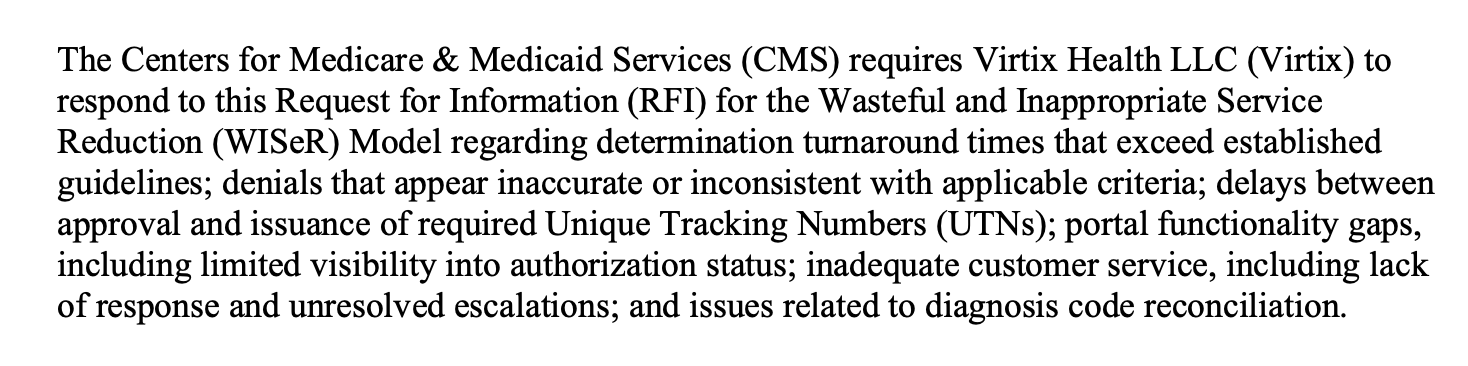
Excerpt from the RFI for Zyter, February 27, 2026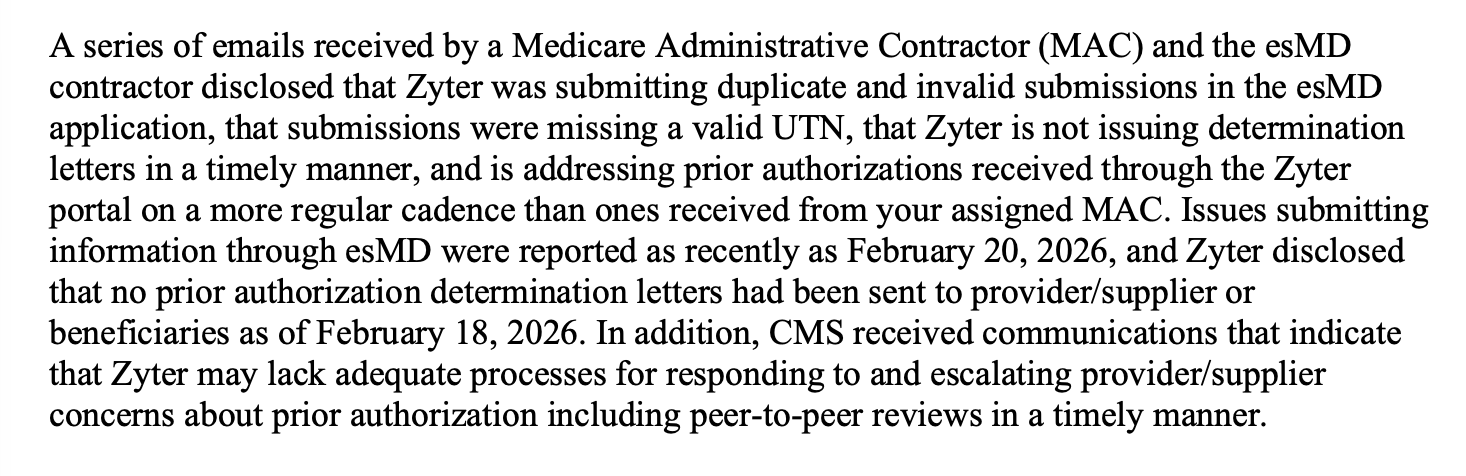
Excerpt from the Performance Notice of Non-Compliance for Innovaccer, February 20, 2026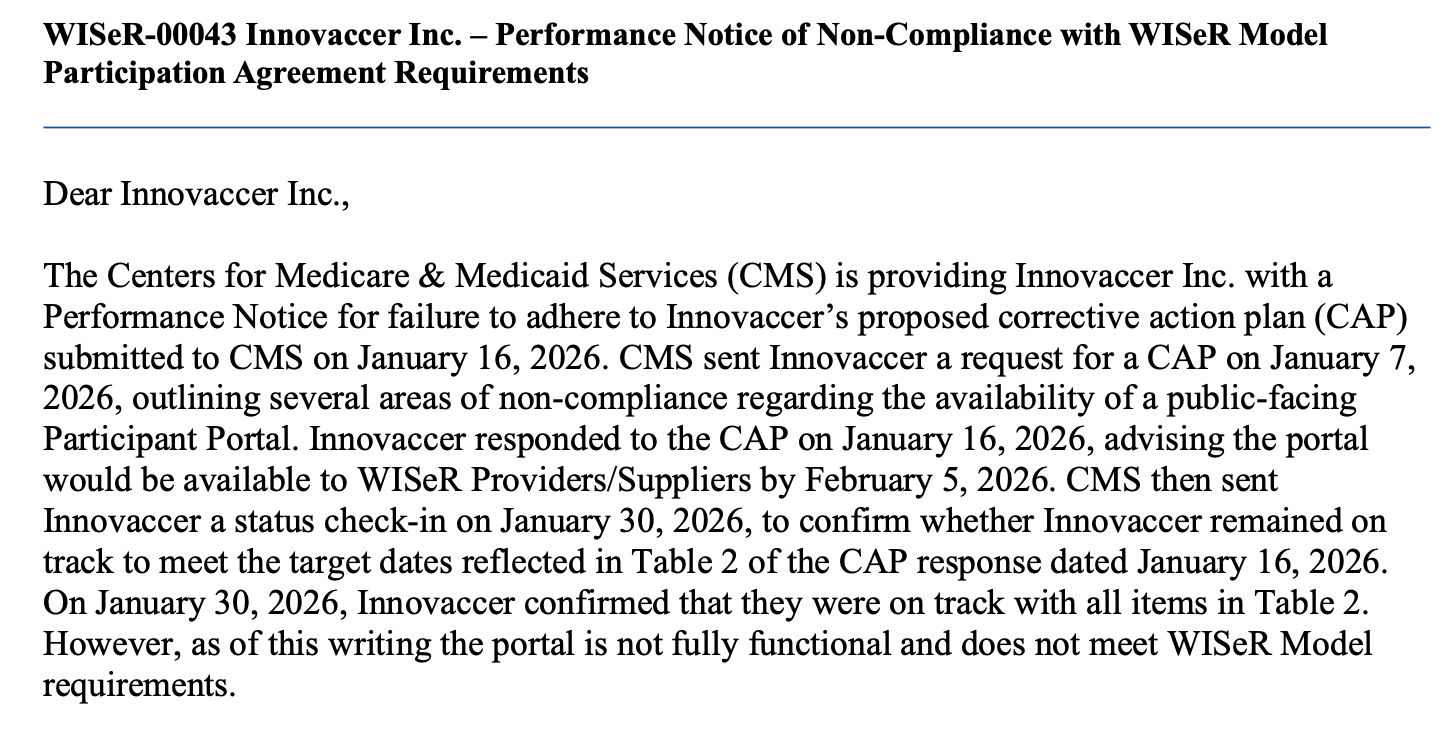
Vendors’ responses to CMS provide further evidence that WISeR’s rushed rollout contributed to its problems. Innovaccer claimed it warned CMS months in advance that it might not be ready to provide full portal functionality by the launch date, even before signing a Participation Agreement. Another vendor claimed that “technical and workflow stabilization challenges were encountered due to the compressed implementation timeframe” it faced after joining the WISeR program a month after the other vendors.
Excerpt from Innovaccer’s Proposed CAP, January 16, 2026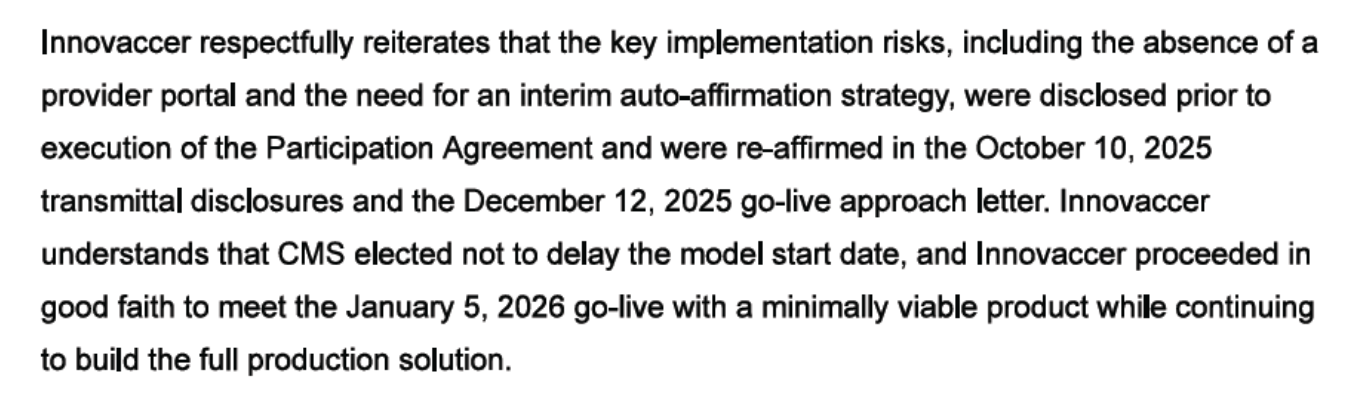
The issues reflected in CMS’s letters to vendors, and the vendors’ responses, illustrate the risks of deploying automated decision-making systems without proper testing or safeguards. While vendors’ responses describe fixes for the problems CMS identified, after-the-fact remedies cannot undo the harms that patients and providers already experienced during WISeR’s rushed rollout.
More Transparency Needed About AI Safeguards
The public still knows far too little about any safeguards that WISeR vendors may have adopted—in part because the government chose to conceal some of this information. Transparency about these safeguards is critical to protecting patients, especially because WISeR’s payment structure gives vendors, as the government put it, “an incentive to deny as many claims as possible.”
Information provided by a vendor about safeguards that it says "ensure the responsible and clinically appropriate application of automation” appears to have been redacted from records released to EFF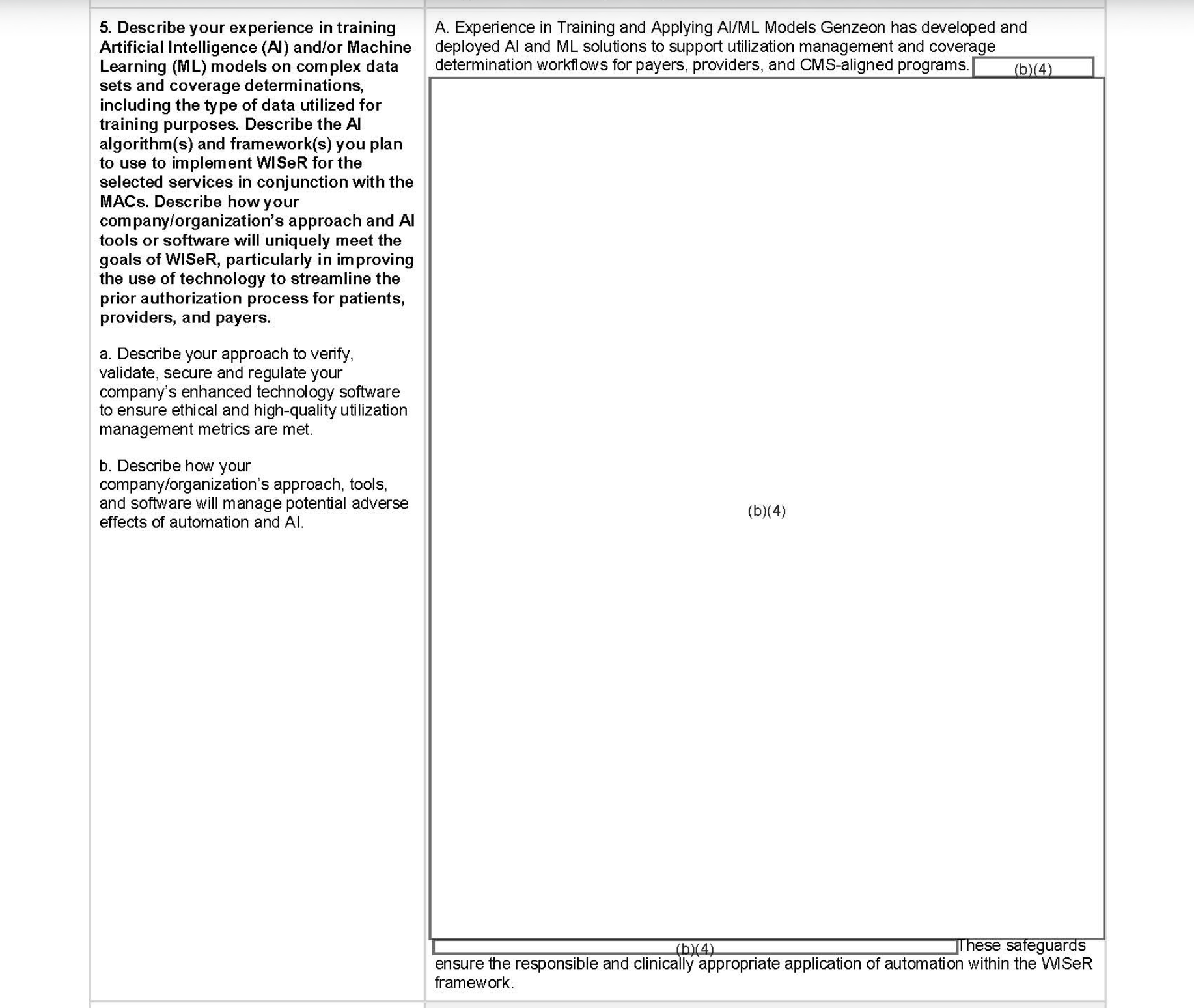
The public has limited means to evaluate the effectiveness of even the safeguards that weren’t redacted from records released to EFF. For example, one vendor’s application touts safeguards like “Human-in-the-loop (HITL) workflows,” “Continuous model monitoring,” and “Transparent audit trails.” Yet it remains unclear whether these measures effectively prevent improper prior authorization denials. Some evidence suggests they may not: the company denied more requests than it approved in the first few months of the program, and CMS inquired about “denials that appear inaccurate or inconsistent with applicable criteria.”
Ultimately, the records obtained by EFF raise more questions than they answer about the safeguards used by WISeR vendors.
Having a Human in the Loop Is Probably Not Enough
CMS has emphasized having a human in the loop as a key safeguard against inappropriate, AI-driven denials. The WISeR FAQ page on the CMS website states that “Non-affirmations will require the review of a human clinician and cannot be performed solely by technology.” But whether human review provides any meaningful protection depends on the details of its implementation, such as whether human reviewers have enough time to evaluate requests and practical authority to override AI recommendations. We still lack many of those details for WISeR vendors.
A growing body of scholarship points to the substantial limitations of “human in the loop” policies as guardrails for AI systems. AI-generated recommendations can unduly influence human decisions, leading reviewers to over-rely on automated judgements and rubber stamp them as correct. Even worse, at least one health insurance company actively pressured clinical reviewers to accept its AI systems’ recommendations. Another company built a system that allowed clinical reviewers to reject claims without opening patient files; clinical reviewers using this system spent an average of just 1.2 seconds on each case.
Is the Right Kind of Data Informing Companies’ Decisions?
Some WISeR vendors’ applications offer general descriptions of the types of data informing their decisions. But far more details are needed to allow medical professionals to assess whether the data inputs to these AI systems are appropriate for evaluating prior authorization requests.
Inappropriate training data or input data can lead to biased, unfair, or inaccurate decisions. CMS guidance for Medicare Advantage organizations using AI to make coverage decisions emphasizes the importance of basing decisions on individual patients’ circumstances. It cautions against using “an algorithm that determines coverage based on a larger data set instead of the individual patient's medical history, the physician’s recommendations, or clinical notes.”
WISeR vendors’ applications reference data sources like “provider behavior,” “patient demographics,” “utilization management datasets,” “provider and payer performance metrics,” and “historical claims data.” Whether these sources could introduce bias or give too much weight to population-level patterns depends on how vendors use them to inform individual decisions. But we don’t yet have these important details about vendors’ data and algorithms. By outsourcing decision-making to private companies’ AI systems, the government has made it harder for the public to evaluate whether decisions are being made fairly.
Next Steps
As the government expands its use of automated decision-making, the potential for consequential mistakes increases rapidly. The records we’ve obtained so far raise questions about the rushed rollout and lack of guardrails for automated decision-making by the U.S. government. EFF urges transparency, oversight, and legal limits to protect people from the harms of automated decision-making in high risk systems.